Considered, conversion-focused websites for ambitious NZ businesses.
Website design in New Zealand should do the heavy lifting while you sleep: fast, on-brand, and structured so visitors actually do what you want them to do. We design and build exactly that.
Faster load, lower bounce, higher conversion
Mobile-first, accessible, easy to update
Wired to your CRM, analytics and lead flow from day one
Good website design is not decoration. It is the mechanism that turns a visitor who found you on Google, Instagram or a referral into someone who calls, books or buys. For most New Zealand businesses the website is doing the job a shop window and a salesperson used to do at the same time, and it has to do it in the first three to five seconds a stranger spends deciding whether to stay or bounce back to the search results. When we talk about website design we mean the whole system: information architecture that puts the right message in front of the right visitor, copy that earns trust before it asks for anything, and a build fast enough that none of that work gets wasted on a slow page.
We hand-build every site from scratch, not assemble it from a bloated template, and you own the finished result outright: the domain, the hosting and the code. That is a deliberate choice, not a technology flex. A hand-built site ships almost no unnecessary code to the browser, which means the pages we build load in under a second on a decent connection, well inside the window where Google's Core Web Vitals reward you and inside the window where a distracted visitor on their phone actually waits around. A site stitched together from a stack of plugins and a heavy template is fighting itself before your content ever loads.
The other half of good design is what happens after launch. A website that looks sharp but sits disconnected from your CRM, your analytics and your enquiry process is a brochure, not a business tool. Every site we build is wired so a form submission lands somewhere useful, page performance is visible in a dashboard you can actually read, and the pages that matter for search (service pages, location pages, case studies) are structured to be found, not just to look good once someone arrives.
That combination, considered design plus a fast honest build plus a working lead pipeline, is what separates a website that quietly earns its keep from one that gets admired once at launch and then ignored.
We start with discovery, not wireframes. A short, focused session to understand the business behind the site: who actually buys from you, what they are worried about before they enquire, what a good lead looks like versus a time-waster, and what 'done' means in numbers rather than adjectives. Too many website projects skip this and go straight to visuals, which is how businesses end up with a site that looks like their competitor's rather than one that reflects how they actually win work.
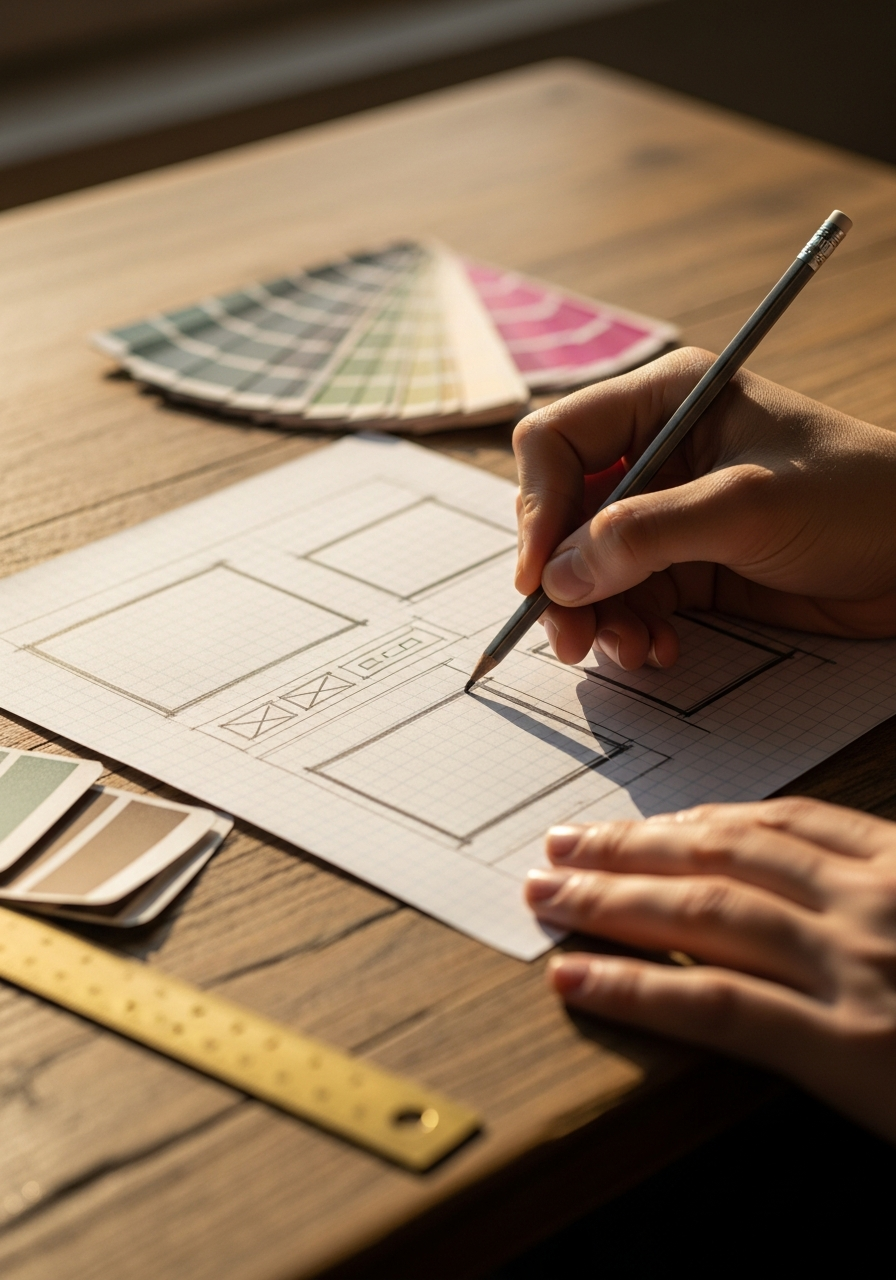
From there we move into design: high-fidelity, clickable prototypes rather than static mockups you have to imagine in motion. You see the actual page flow, the actual copy in place (not lorem ipsum), and you can react to the real thing before a single line of code gets written. This is where most of the thinking happens, and it is far cheaper to change a layout decision here than after the build.
The build itself is hand-coded from scratch and set up on fast, secure infrastructure you fully own, with the SEO foundation (page structure, metadata, schema markup, internal linking) laid in as we go rather than bolted on afterwards. We treat accessibility and mobile layout as first-class requirements throughout the build, not a final pass, because the majority of New Zealand traffic to most local and service-based sites now arrives on a phone.
Launch is not the finish line. Every build includes analytics and a short review cadence afterwards, so we (and you) can see what pages are actually converting, where visitors are dropping off, and what the next round of improvements should focus on. A website is a system you tune, not a project you close.
A typical project runs through four stages. Discovery, usually a single focused workshop, establishes the brief: audience, competitors, tone, the handful of actions you actually want a visitor to take, and any technical constraints (existing brand guidelines, an existing CRM or booking tool that needs to plug in, content you already have versus content we need to write).
Design turns that brief into clickable prototypes, page by page, with real copy drafted alongside the layout so you are judging the actual experience rather than a placeholder. This stage typically covers the homepage, core service or product pages, an about or credibility page, and a contact or booking flow, with the structure for any repeating page types (locations, case studies, blog) agreed before we template them.
Build is where the prototypes become a working site: hand-coded, purpose-built components, a CMS or content structure you can actually update yourself where that matters, forms wired to email or your CRM, analytics installed, and a pass on every image, heading and meta tag for search. We test across real devices, not just a browser resize, because a layout that looks fine on a laptop can break on the phone most of your visitors are actually using.
Launch includes domain and hosting cutover, redirects from any old URLs so you do not lose existing search rankings, a final QA pass for broken links and console errors, and a short period afterwards watching real traffic to catch anything that only shows up under real-world use. For most business sites this whole run takes four to eight weeks depending on how much content needs writing from scratch and how many page types are involved.
The single biggest cost driver is content volume and structure, not visual complexity. A five-page brochure site with content you already have is a very different job from a thirty-page site with service pages, location pages and a blog that all need writing, structuring and optimising for search. Custom copywriting, especially copy meant to rank and convert rather than just describe, takes real time and it is usually the line item people underestimate.
Functionality is the second driver: a contact form is trivial, but a booking system with availability logic, a members' area, an ecommerce catalogue with variants and payment processing, or an integration into an existing CRM or practice-management tool all add real build time. It is worth being specific about what the site needs to do, not just look like, before pricing gets discussed.
As a rough honest range: a focused five-to-eight-page business site typically lands in the low thousands to mid five figures depending on content and integrations, a larger multi-service or multi-location site with dozens of pages and heavier SEO investment moves into the mid-to-high five figures, and anything with custom ecommerce or a bespoke booking or membership system needs its own scoped quote because the variables are too wide for a rule of thumb. Ongoing hosting on the fast, secure infrastructure we use is genuinely cheap, usually a fraction of what a heavier, plugin-dependent hosting setup charges, which matters over the life of the site.
We never give a binding number without seeing the actual scope first. Anyone who quotes a firm price before understanding your content, integrations and page count is guessing, and that guess tends to grow once the real requirements surface.
Before you commit to a website designer or agency, ask to see live sites they have actually built and shipped, not just polished mockups. Load one on your phone on mobile data, not office wifi, and see how it actually feels. Ask how it was built and why; a bloated, slow-loading site that takes four seconds to load is a real cost every month it stays live, in bounce rate and in search ranking. Ask who owns the domain, the hosting account and the code once the project ends, because 'we'll host it for you forever' sometimes means you never actually own your own website.
It is also worth asking what happens after launch. Does the price include any support, or does every future edit come at an hourly rate with a wait? Is there any reporting on how the site is actually performing, or does it go dark the day it goes live? A website design partner who disappears after handover has sold you a one-off asset, not an ongoing tool.
New Zealand's specific buyer behaviour makes speed and mobile experience non-negotiable rather than nice-to-have. The overwhelming majority of local searches, whether for a tradesperson, a clinic or a professional service, now happen on a phone, often while the person is actually standing in front of the problem they are trying to solve. A slow site or one that requires pinch-zooming to read a phone number loses that visitor to the next result down, and New Zealanders comparison-shop fast: two or three tabs open, a quick scan, a decision inside a minute. Local hosting speed also genuinely matters here; a site served from a fast global edge network reaches a Kiwi visitor with far less latency than one sitting on a single distant server, and that difference shows up directly in load time and in how Google ranks you for local search.
New Zealand business culture also rewards directness over polish. Overseas template sites with generic stock photography and vague 'solutions' language read as slightly off to a local audience used to plain, specific, no-nonsense communication. A site that states clearly who you are, what you actually do, what it costs (even as a range) and how to reach a real person tends to convert better here than one leaning on hype.
A short workshop to understand your business, your audience, and what success looks like in numbers.
High-fidelity prototypes you can click through, with copy that earns trust before it asks for a click.
Hand-built for speed and security, with the SEO foundation laid as we go. No bloated page builder slowing you down.
Ship, measure, refine. Monthly review of what is working, plus a roadmap of next moves.
It depends mostly on content volume and functionality rather than visual style. A focused five-to-eight-page business site typically sits in the low thousands to mid five figures, a larger site with many service or location pages and heavier SEO work moves into the mid-to-high five figures, and ecommerce or custom booking systems need their own scope-based quote. Anyone offering a firm number before seeing your actual content and requirements is estimating, not quoting.
Most business sites take four to eight weeks from discovery to launch, depending on how much content needs writing from scratch and how many distinct page types are involved. A simple brochure site with content already prepared can move faster; a site with dozens of service and location pages, or a custom booking flow, takes longer because the content and functionality both need real time.
A hand-built site ships very little unnecessary code to the browser, so pages load fast without relying on a stack of plugins to compensate. It runs on fast, secure infrastructure without the maintenance overhead of a traditional plugin-based setup: no plugin updates, no security patching treadmill, and hosting costs that are usually a fraction of a managed, plugin-heavy plan. The trade-off is that day-to-day content edits need a proper content structure set up at build time rather than a generic drag-and-drop interface, which we account for in the build.
Design and technical build lay the foundation (fast load times, clean structure, correct metadata and schema) but ranking depends on ongoing content and authority-building work beyond the initial build. We lay that foundation properly on every site we design, and if search visibility is the goal we would usually pair the build with an ongoing SEO programme rather than treat the website as a one-off project that ranks itself.
Yes. You own the domain, the hosting account and the code. This is worth confirming with any agency before you sign, because some hosting arrangements effectively lock a business into paying the original builder indefinitely to keep the site live or make basic changes.
For most builds, yes, through a content structure set up specifically for the pages you are likely to change (services, pricing, team, blog posts). For anything more structural, changes to layout or new page types, that typically goes back through the build process rather than a drag-and-drop editor, which is part of the trade-off for the speed and reliability a hand-coded site delivers.
We work with businesses right across the country. Start with your city.
Website Design works best alongside the rest of what we do. These are the ones it pairs with most often.
Technical foundation, topical authority, and content that compounds.
Quiet automations behind the scenes, replacing the busy-work nobody should be doing.
A real publishing rhythm across Instagram, TikTok and Meta, briefed to revenue, not vanity.
A 30 minute discovery call is the fastest way to find out if Website Design is the right move for your business.
Call 020 4164 7596